
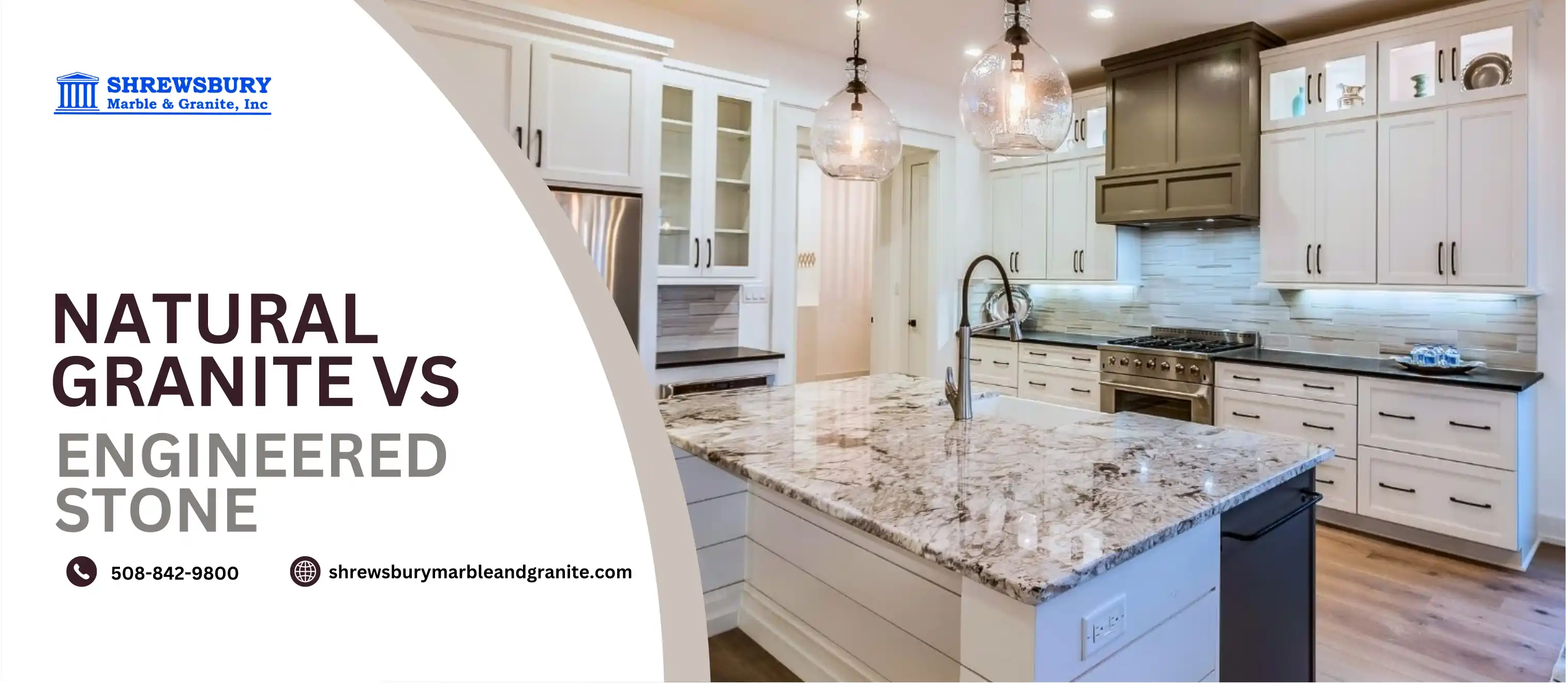
The U.S. market for stone countertops is busy right now, growing about 4.2% every year. According to 2025 data from the National Kitchen & Bath Association, natural granite countertops still claim 35% of all installs.
For homeowners here in Massachusetts, the choice usually comes down to two big contenders: natural granite or engineered stone. Both make for durable kitchen counters, but they offer very different value in the long run. As the leading marble and granite supplier in Northborough, Westborough, Grafton, Millbury, Clinton, Holden, Marlborough, and Worcester, MA, we help clients weigh these options every day at our Shrewsbury store.
Here is the real truth about the natural granite and engineered stone differences to help you decide.
Granite is 100% natural. It forms deep underground from magma that has cooled. It’s made of minerals like quartz, feldspar, and mica that were pressed together under heat for millions of years. Because it comes from the earth, every single slab is different.
The main advantage is durability.
These slabs are heavy, about 18 to 20 pounds per square foot, so your cabinets need to be sturdy. You have over 3,000 color options, from deep blacks to rare blues, all mined from quarries around the world. Over time, granite develops a patina, which is a subtle change in sheen that adds character.
Engineered stone (commonly called Quartz) is a manufactured product. It is usually a blend of 90% crushed natural quartz mixed with resins (glues) and pigments. Factories press this mix under a vacuum to create uniform slabs.
This process removes the "wild" factor. Manufacturers can print veins to look like marble or granite, but the pattern is controlled.
The Pros and Cons:
| Feature | Natural Granite | Engineered Stone (Quartz) |
|---|---|---|
| What is it? | 100% Natural Stone | 90% Quartz + 10% Resin |
| Pores | Low (Needs yearly sealing) | None (No sealing needed) |
| Heat Limit | High (1,200°F) | Low (300°F) |
| Scratch Proof | Very High | High |
| Cost (Installed) | $40 - $100 / sq ft | $50 - $120 / sq ft |
| Care | Seal yearly, clean spills | Just wipe it down |
| Look | Unique, random patterns | Uniform, consistent |
Both materials handle heavy kitchen use, but your lifestyle decides the choice.
Choose Granite Kitchen Countertops if:
You cook a lot. The ability to set hot pans down anywhere is a luxury. You also get the aesthetic depth that only nature can provide. Plus, it adds value. 2024 real estate reports suggest homes with granite sell about 5% faster. It’s timeless.
Choose Engineered Stone if:
You hate maintenance. If you have kids and worry about grape juice stains, this is your safest bet. It offers a cleaner, more modern look.
Living in Central Massachusetts means dealing with humidity changes. Granite handles this well, but we recommend using an impregnating sealer to protect it from local climate shifts. Engineered stone generally ignores humidity entirely.
At our marble and granite store in Shrewsbury, MA, we stock slabs from Brazil, India, and Africa. We invite you to visit our showroom and see the slabs in person. Seeing the stone under good lighting makes a huge difference.
You need to seal granite, usually, once every 6 to 12 months. Do the water test: if water drops sit on top, it's fine. If the stone darkens and soaks it up, it’s time to seal it.
Yes. Both granite and engineered stone can chip if you hit them hard enough. However, granite is often easier to repair because the epoxy blends into the natural pattern better.
We recommend plywood or cement boards to keep things stable.
At Shrewsbury Marble and Granite, Inc, we deliver and install granite across the Worcester and Northborough areas.