
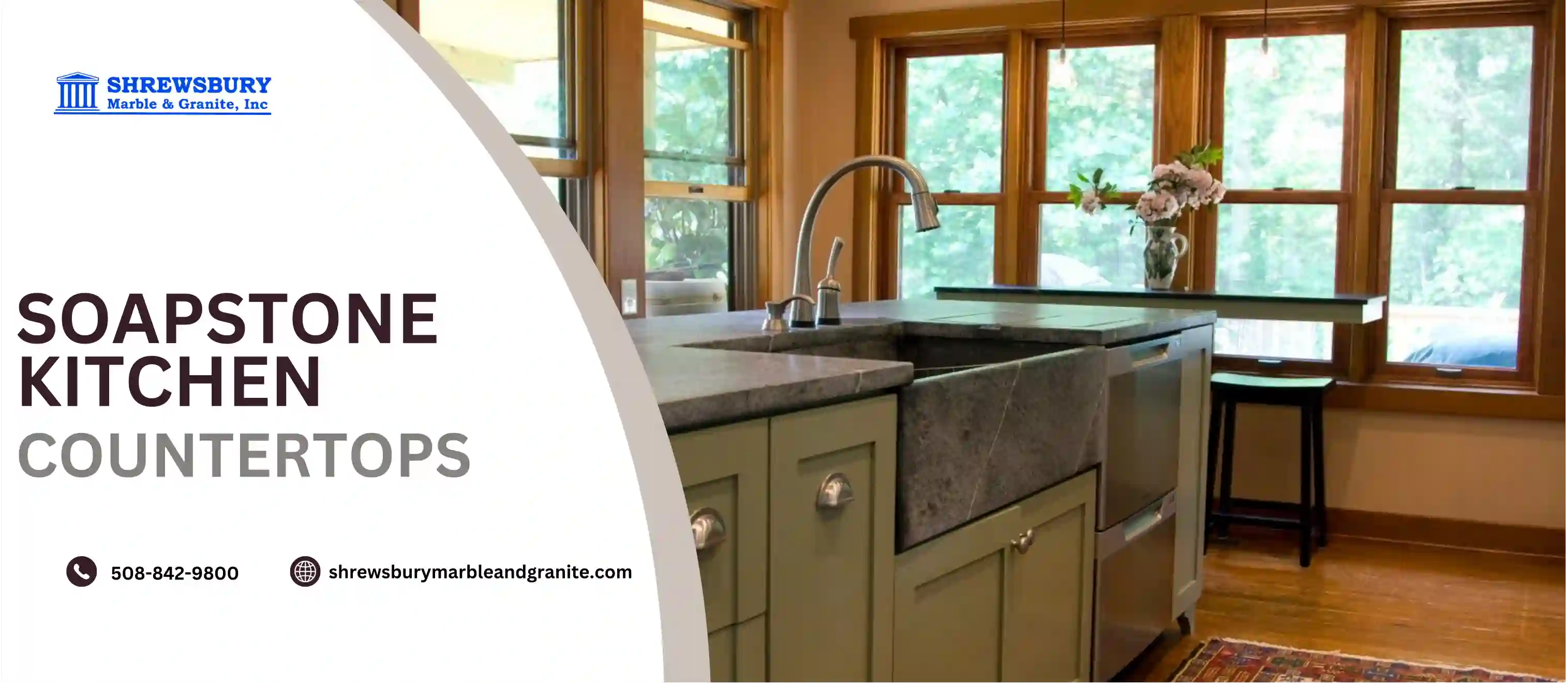
Yes, soapstone is a good kitchen countertop material for homeowners who cook often and want a surface that takes heat, resists stains and never needs sealing. Soapstone kitchen countertops are dense and non-porous, so lemon juice, red wine and hot cast-iron pans leave no lasting damage. The trade-off is softness. The stone scratches more easily than granite, yet light sanding and mineral oil remove most marks within a few minutes.
1. Introduction
2. Is Soapstone a Good Choice for a Busy Kitchen?
3. Are Soapstone Kitchen Countertops Heat Resistant?
4. Does Soapstone Stain or Scratch Easily?
5. How Can You Remove a Scratch from Soapstone?
6. How Do You Maintain Soapstone Kitchen Countertops?
7. Soapstone vs Granite vs Quartz: Which Is Better for a Kitchen?
8. Which Soapstone Colors Are Available in Shrewsbury, MA?
9. How Does the Soapstone Installation Process Work?
10. Frequently Asked Questions
Soapstone works well in busy kitchens because it handles heat, acids and spills better than most natural stone countertops. It does not etch like marble, and it does not need sealing like granite. Many keen cooks also love its soft, velvety feel under the hand. However, knives and dropped pans can leave marks, so it suits homeowners who welcome a surface that gathers character over time.
Yes. Soapstone is one of the most dependable choices for a heat-resistant countertop. The stone absorbs heat and spreads it evenly, which explains why builders have used it for wood stoves and fireplace hearths for generations. You can place a hot pot from the stove straight onto the surface without cracking or scorching it. Many owners still keep a trivet nearby to protect the oiled finish.
Soapstone rarely stains, but it does scratch. Its dense, non-porous surface keeps wine, coffee and lemon juice sitting on top, so a quick wipe removes them. Scratches are an honest drawback. Architectural soapstone measures roughly 3 to 4 on the Mohs hardness scale, while granite sits near 6 to 7. Most marks stay shallow, though, and you can repair them at home in minutes.
Everyday soapstone countertop maintenance takes very little effort. Clean the surface with warm water and mild dish soap. You never need to seal it. Many owners apply food-safe mineral oil weekly for the first few months, then every month or two after that. Oiling is optional, but it darkens the stone evenly and hides fingerprints, so the color looks rich rather than patchy.
The right choice depends on how you cook. In the soapstone vs granite debate, granite wins on scratch resistance, while soapstone wins on heat tolerance and needs no sealing. Quartz offers a uniform look with little upkeep, but its resin binder can scorch under hot pans. Choose soapstone if you value a matte, lived-in finish over a polished, flawless one.
| Feature | Soapstone | Granite | Quartz |
|---|---|---|---|
| Heat resistance | Excellent | Very good | Fair, resin can scorch |
| Stain resistance | Excellent | Good when sealed | Excellent |
| Scratch resistance | Low to moderate | High | High |
| Sealing | Not needed | Every 1 to 2 years | Not needed |
| Finish | Matte, darkens with age | Polished or honed | Uniform and polished |
Shrewsbury Marble and Granite stocks four soapstone varieties in its showroom at 620 Boston Turnpike. Soapstone is far less common than granite or marble, so many homeowners in Worcester, Framingham and Northborough struggle to find full slabs to compare. Seeing them side by side helps, because color and veining change from slab to slab, and every piece darkens once oiled.
Vermont Soapstone
Vermont is a premium stone with the highest demand in the range, and it remains a popular pick for soapstone kitchen countertops in New England homes.
Barocca Soapstone
Barocca has a warm, honey-like tone that brings softness to kitchens with wooden cabinets or open shelving.
Green Soapstone
Green soapstone shows a light green base with white and gray veining. It also works well for sinks, though the paler shade needs regular care.
Silver Soapstone
Silver is one of the rarest varieties available. It's cool gray tone pairs easily with stainless steel appliances and white cabinetry.
Each order follows clear stages, so you always know what comes next. You choose a slab at the showroom, and a templater then visits to measure your cabinets. Before any cutting begins, the team places your layout digitally on the slab so you can approve the veining. Adapted vehicles deliver the stone, and you receive a maintenance guide for your new soapstone kitchen countertops.
Soapstone usually costs about the same as mid-range to premium granite. The final price depends on the variety, slab size, edge profile and number of seams. A free estimate from Shrewsbury Marble and Granite gives you an exact figure for your kitchen layout.
You should always use a cutting board. Knife blades leave visible scratches on the soft surface and blunt quickly against stone. If a cut mark does appear, light sanding with fine sandpaper and a fresh coat of mineral oil will blend it away.
Yes. Soapstone darkens naturally as it meets oils, water and daily use. Unoiled stone often darkens unevenly, especially around the sink and stove. Regular mineral oil treatment speeds up this change and creates a deeper, even shade across the whole surface.
Soapstone can chip at sharp corners when a heavy pan strikes the edge. Cracks are rare once the slab sits on level, well-supported cabinets. Choosing a rounded or eased edge profile reduces chipping, and you can often sand small chips smooth yourself.