
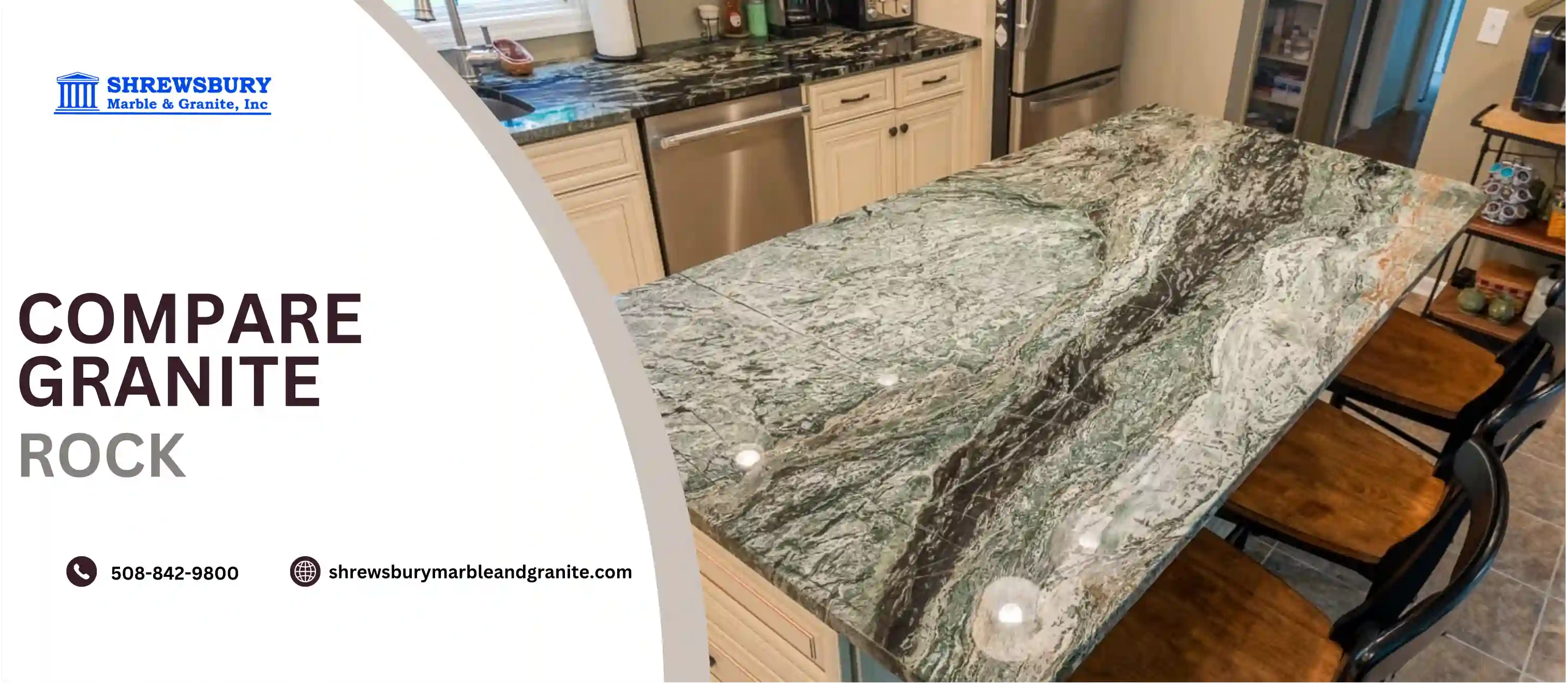
Natural granite forms deep below the earth's crust as molten rock cools slowly over millions of years. That slow underground cooling locks quartz and feldspar crystals together with dark mica flecks to create a hard, dense stone. Because mineral mixes change from one region to the next, different types of granite rock look very different once sliced into countertop slabs. At Shrewsbury Marble and Granite in Shrewsbury, Massachusetts, homeowners can look through 300 stocked granite colors before the fabrication shop cuts and installs the stone for kitchens, bathroom vanities, or fireplace surrounds.
Some quarries produce stone with a tight, uniform speckle, while other rock formations have sweeping ribbons of color that run from one end of the block to the next. On its granite product page, Shrewsbury Marble and Granite highlights four specific varieties that show how different types of granite rock vary in grain and color:
| Granite Variety | Grain and Color Pattern | Where It Works Well |
|---|---|---|
| Absolute Black | Tight, even dark grain with very little visual movement. | Modern kitchens and baths that call for a quiet, solid counter. |
| African Bordeaux | Warm South African stone with blended brown and rust bands. | Center islands and counters paired with natural wood cabinets. |
| African Dream | Sweeping, abstract waves running through warm earth tones. | Statement kitchen counters, vanities, and indoor feature walls. |
| African Ivory | Light cream and ivory mineral grains with a warm cast. | Dim kitchens and bathrooms that need a brighter work surface. |
Choosing between uniform stone and heavily veined stone changes how the fabrication shop lays out the project. Most L-shaped kitchens and long counter runs need at least one seam where two pieces of stone meet.
On a tight, consistent stone like Absolute Black, joining two pieces at a corner leaves a very subtle transition because the grain looks the same in every direction. On a directional stone with bold waves like African Dream or African Bordeaux, the fabricator has to match the angle of the mineral bands so the pattern does not stop abruptly at the seam.
After the homeowner picks a slab, a templater visits the house to measure the installed base cabinets. Before cutting begins, the shop places a digital layout over the slab so the homeowner can see how the veining will flow around sink cutouts and corners.
Across different types of granite rock, the mineral hardness handles daily cooking and heat near a stove or fireplace opening. Even so, the shade of the stone changes what shows up on the counter between cleanings.
Mirror-polished black stone reflects overhead room lights like glass. Dry flour, dust, and water rings show up quickly on a dark counter, so a quick wipe with a soft cloth after cooking keeps the surface looking sharp.
Pale stones like African Ivory hide dry dust and crumbs much better during the day. However, porous light stone will show dark coffee or cooking oil marks if the surface sealer wears thin. Wiping spills promptly with warm water and mild dish soap and keeping up with periodic sealing stops liquids from sinking into the microscopic pores between the mineral crystals.
Once the digital template is approved, shop saws cut the slab to match the room measurements and shape the outer edge profile. Because quarried rock is heavy, the base cabinets underneath need to sit level and sturdy before installation day.
Shrewsbury Marble and Granite hauls the finished pieces in adapted delivery trucks and sets the stone in place for homeowners in Shrewsbury, Worcester, Auburn, Framingham, Holden, Grafton, and Northborough. After the crew levels the slabs and seals the surface, the homeowner receives care instructions for the new stone.
Homeowners comparing natural stone slabs for a remodel often ask a few practical questions before picking a granite variety.
Mineral cooling speed and underground earth movement shape the look of the rock. Stones that cooled evenly form tight, speckled crystals like Absolute Black, whereas rock that shifted while still molten forms long, sweeping ribbons of color like African Dream.
Quarry supply sets the price of natural stone. High output from large quarries in India or China keeps dark stones like Absolute Black in a lower price bracket. Smaller quarries in South Africa pull out much less rock each year, so patterned slabs like African Bordeaux cost more to buy.
Uniform speckled granite looks the same from any angle, so corner seams are easy to blend. Heavily veined slabs have a clear direction to the grain. Shop staff place a digital template over the slab before cutting so the mineral waves line up cleanly at the joint.
Dark polished granite hides dark food spills well, though surface dust and water smudges show up faster under kitchen lights. Light ivory granite hides dry dust better, though keeping the stone sealed prevents coffee or cooking oil from darkening the pale pores.
Because igneous rock handles moisture and radiant heat well, installers fit custom granite slabs onto bathroom vanities and around indoor fireplaces. Swirling varieties like African Dream also go onto vertical interior walls.
Comparing different types of granite rock in person makes it much easier to see how fine speckles and bold mineral waves look under room lighting. If you are planning a kitchen, bath, or fireplace remodel, Shrewsbury Marble and Granite has 300 granite colors in stock from quarries in Brazil, India, and Africa. Visit the Shrewsbury showroom to view full slabs and schedule a template measurement for your home.